Monday, January 20, 2020

War Is Hell (Again)


Both the beauty and the aggravation of Sam Mendes’s 1917 can be summarized in its opening and closing shots. The film opens with an image of a picturesque meadow, in which are camped a battalion of British soldiers; the camera sweeps over the encampment and focuses on one soldier resting against a tree in the full bloom of spring. In the final shot of the film, a soldier is also seen resting against a tree, only this tree is dead and barren. The symbolism is obvious and self-important.


And that is the problem with 1917. There is no doubt that 1917 is a beautifully shot, well-acted, and compelling movie. It will undoubtedly win multiple Oscars of the ten for which it has been nominated, and deservedly so. It provides two hours of first-rate film-going entertainment. But for the cinematically literate, 1917 is a poser – an exercise in imitation of other great war films (Apocalypse Now, Saving Private Ryan, and Platoon, to name three), and an example of directorial self-consciousness, most notably in the decision to use a single camera deftly edited to give the film the appearance of being shot in one long continuous take.

The story follows two British soldiers, Lance Corporals Blake and Schofield, who are sent on an urgent mission, crossing enemy lines to deliver a message that could save 1600 soldiers from a German trap. (How the two battalions got behind the lines is unexplained.) It is an original screenplay inspired by stories Mendes was told by his grandfather, a Lance Corporal in WWI, to whom the film is dedicated. There is little in the way of character development – the mission is the focus – and at times devolves to caricature (is every British field commander arrogant and self-obsessed?). It takes advantage of war film conventions that stretch credulity (are all Germans such terrible shots?) and on multiple occasions, makes narrative choices and adds contrived coincidences that caused me to shake my head.

Relative unknowns Dean Charles Strong (Blake) and George MacKay (Schofield) both give strong, grounded performances as the two leads, with a naturalness that avoids melodrama. A few, more familiar, faces appear in smaller roles (Colin Firth, Benedict Cumberbatch). 

But the real star of the film is Roger Deakins’s Oscar-worthy cinematography, which offers truly memorable images that require no dialogue to tell the story. Deakins, whose previous work with Mendes on Skyfall won him an Oscar, makes the most of Mendes’s decision to use the “continuous take,” shifting the point of view of the camera so that it moves like a pesky fly behind, before, and above the characters. This provides some relief from what could become visual monotony and allows Deakins a somewhat broader range for his camerawork.


The single-take approach, famously employed in Hitchcock’s Rope and Iñárritu’s Birdman or (The Unexpected Virtue of Ignorance), is effective in creating an immersive experience and a bond between the viewer and the main characters of the film. But it also has some unfortunate effects. The first is that at times it draws attention to itself and not to the story and feels gimmicky. A second is the issue of time. The film compresses roughly 20 hours of chronological time into two hours of screen time, so that the sensation of time is manipulated – at times compressed, at other time dilated. (Can a soldier emerge soaking wet from a river and then have his uniform completely dry in five minutes?). Additionally,the single-shot technique has the linear effect of a theme park attraction, taking the viewer on a ride through a sequence of set pieces. I can’t recall a recent film in which the storyboarding was more obvious.

1917 functions more as a suspense film than a war film. It is limited in scope and focuses on the fate of the two messengers. And while it has some action sequences, they lack the immediacy and intensity of Saving Private Ryan or the epic sweep of Patton. It lacks the patriotic swell of Dunkirk or the social commentary of Apocalypse Now or Full Metal Jacket. On the positive side, Thomas Newman’s score is first-rate and Lee Smith’s editing moves the film briskly along.

War is hell, we are told; and to an extent all war films are an exercise in katabasis – going “to hell and back” – rehearsing the ancient myth of Orpheus and the underworld journey of Odysseus. (Coppola’s Apocalypse Now, borrowing from Josef Conrad’s Heart of Darkness, took this literally). Directors therefore are often tempted to reach for higher meaning through symbols and metaphors to give mythic heft to the narrative. Not handled well, it can lend an aura of preachiness or self-importance to the film. Trees are the symbol Mendes employs, to varying degrees of success. It is no surprise that the most moving scene in the film takes place in a stand of trees. At other times, however, it seems forced, as in the closing shot.

1917 won the Golden Globes for best dramatic film and best director and has been nominated for ten Academy Awards. There have certainly been less-deserving winners in recent years. Despite its flaws, it is a well-made film worth seeing, but it is far from a masterpiece.  3.0 stars out of 4.0.

Friday, January 3, 2020

A Parable of Grace


One of the most famous – and surprising – friendships in the history of the U.S. Supreme Court was between Ruth Bader Ginsburg and her high-court nemesis Antonin Scalia. Despite their hard-fought ideological battles, they managed to look past their differences to appreciate the humanity in each other. A similar odd-coupling is portrayed in the recent Netflix release, The Two Popes, directed by acclaimed South American filmmaker Fernando Meirelles (City of God, The Constant Gardener). The film imagines an ecclesiastical summit between ideological opposites – conservative Pope Benedict XVI (Anthony Hopkins) and progressive Argentinian cardinal Jorge Borgoglio (Jonathan Pryce) – who would later become Pope Francis I. The film is not only an acting delight – Hopkins and Pryce are magnificent in their craft – but is also one of the most spiritually rich films of the decade, and has been nominated for four Golden Globes, including Best Picture - Drama.

Though portrayed as historical fiction or even a docudrama, the core of the film is a fictional two-day meeting between the “two popes” in the lead-up to Benedict’s decision to resign the papacy in 2013. As with Milos Forman’s Amadeus, which took even greater historical liberties, the point isn’t in the history but in the confrontation of opposites and the theological and personal narratives that result. And what results is a parable of grace as these two aging men, each with their own demons, each with a deep distrust of the other, begin to hear God’s voice through the other – which becomes a means of grace and reconciliation.


The film was originally conceived as “The Pope” (before Hopkins’s agent insisted on the title change) and it is clearly more Francis’s story than Benedict’s. Borgoglio is the popular champion of the poor and advocate for reform, Benedict the lonely academic and defender of tradition who as Cardinal Joseph Ratzinger was the “German rottweiler” of institutional orthodoxy. Borgoglio is given an extensive backstory – his call to the priesthood, his controversial role during the years of military dictatorship in Argentina – that is not given to Ratzinger, who historically may be the more interesting character.

Meirelles is at times unclear as to whether he wants to tell the story of the two men or of the church’s struggle with modernity, power, and abuse. From a filmmaking perspective, the film is strongest when it focuses on the men and weakest when it preaches about the church and society (for example, a debate about “walls” cuts to an anachronistic clip of the construction of the US-Mexico border wall). Matters such as the child sexual abuse scandal or financial corruption in the Vatican are mentioned but not explored. The film has an unnecessary coda celebrating Francis’s papal speeches and a silly ending that detracts from the rest of the film.

But it is not fair to criticize a film for what it isn’t, and these are relatively minor quibbles in a film that is rich in well-acted dialog and spiritual meaning. How does one hear the voice of God? What is the mission of the church? How does one balance purity of purpose with pragmatic obligations? How do we treat our enemies? How do we find forgiveness? These are just some of the issues tackled in the marvelous screenplay (also nominated for a Golden Globe).

The Two Popes is a rich feast for the theologically inclined, perhaps less so for skeptics and cynics – but even they will appreciate the magnificent performances of Pryce and Hopkins, the first-rate writing, and the incredible recreation of the Sistine Chapel. It is rated PG-13, presumably for the few scenes of state-sponsored terrorism in flashback. The film is currently available on Netflix and may be showing theatrically in select cities. 3.5 stars out of 4.0.

P.S. I must confess a personal connection to the theological debates in the film: my essay on “Marriage Equality in the PC(U.S.A.)” is juxtaposed with an opposing essay by Ratzinger in the textbook Readings in Christianity (3rd edition). I doubt he’s aware of that, though.


Tuesday, November 26, 2019

Man vs. Machine


At one point in James Mangold’s enthralling and thoroughly entertaining Ford v Ferrari, Henry Ford II – grandson of the iconic automaker, and CEO of Ford Motor Co. – points out his nineteenth story office window at a nearby assembly plant. “During World War II that plant turned out 3 of every 5 bombers used in the war. Do you think Roosevelt defeated Hitler?” His point is clear: wars are not won by individuals but by organizing and mobilizing the machinery of corporate industry.

The year is 1965 and Ford is at war – not in Vietnam (which is never mentioned in the film) but with Ferrari, the Italian automaker which is the perennial champion of the prestigious 24 hours of Le Mans race. What is more, Enzo Ferrari has insulted and humiliated the American automaker and its corporate baron. Mr. Ford’s audience is Carroll Shelby, the only American ever to win at Le Mans and the best sports car designer in America. At the urging of marketing genius Lee Iacocca, Ford has enlisted Shelby to beat Ferrari and win a much-needed marketing boost for the brand.

But Ford was wrong. Wars are not won by Presidents or corporations. They are won by the soldiers whose bravery, sacrifice, and heroism are put to the test on the battlefield.


So enter Ken Miles, the British-born World War II veteran whose single-minded determination to race makes him a one-man killing machine (metaphorically) on the racetrack battlefield. Miles is driven not by corporate loyalty, or even a drive to win, but a Zen-like quest for “the perfect lap” – and that moment of transcendence, when, “at 7,000 RPM… everything fades. The machine becomes weightless. It just disappears. All that's left (is) a body moving through space and time.”

Ford v. Ferrari is at once an homage to the age of American industrial greatness as well as a critique of the corporate mentality which contributed to its downfall. Indeed, the central conflict in the film is not between Ford and Ferrari. Rather, it is, in the non-inclusive language of the era, between Man and Machine. On one level the “man” is Carroll Shelby, whose Patton-like genius is constantly being constrained by the corporate machine; on another level the man is Ken Miles whose desire for the perfect communion of car and driver is constrained only by the limits of engineering and the laws of physics on his speed machine.

The retro look at industrial America in its prime also suggests another conflict, between the promise of the “American Century” and the harsh reality of corporate and political greed that has turned industrial America into the Rust Belt. It taps into the nostalgic longing of many to “make America great again” by invoking an era of white male American dominance. One must look hard to find a person of color in the film; and the only woman of note is Caitriona Balfe’s fabulous turn as Mollie Miles, whose strength of will and character is a perfect foil for her husband. (In earlier years, the role would be played by Katherine Hepburn or Rosalind Russell.)


But the politics of Ford v. Ferrari takes a back seat to the sheer brilliance of the filmmaking. Mangold, whose previous credits include Walk the Line and The Wolverine, provides a film that excels in every way. The writing is crisp and witty. The editing is brisk, so that despite the hefty 152 minute run time, the story never lags. The cinematography is breathtaking, and the score is a perfect amalgam of bluegrass-rock and techno-pop. But the real gem is Christian Bale’s performance as Ken Miles. Bales continues to turn out one great performance after another, and this could be his best yet. Matt Damon also gives a solid performance as Carroll Shelby, as does young Noah Jupe as Miles's son Peter. 

Ford v. Ferrari invokes the era of great auto-racing films like Grand Prix (1966), Winning (1969) and Le Mans (1971), and leaves them in the dust. It may be the best auto-racing film ever made and is certainly one of the best films of the year.

Rated an overly restrictive PG-13 for “some language and peril” – Ford v. Ferrari is a real winner. **** (4.0 stars/4.0)

Friday, November 22, 2019

Yes, Virginia, There IS a Mr. Rogers


Every year, Hollywood trots out so-called “holiday films” that repackage the timeless (perhaps time-worn) story of how the spirit of Christmas transforms the cynical and selfish Scrooges and Grinches of the world into real persons of compassion and generosity. They are a ritual of the season as much as New Year’s resolutions, and usually just about as lasting in their impact. They offer feel-good sugar highs that collapse under the weight of their own fiction.

Marielle Heller’s A Beautiful Day in the Neighborhood – the long-awaited film featuring Tom Hanks as children’s television icon Fred Rogers – is not (thank God) a Christmas movie. But it is the rare holiday release about character transformation that works because, unlike the jolly elf of our secular Christmas mythology, there really is (or was) a Mr. Rogers.

Based on a now-classic 1998 profile of Mr. Rogers (“Can You Say… Hero?”) by Tom Junod, the film features all the familiar character tropes of a Christmas film: the cynical, worldly journalist Lloyd Vogel (a loose depiction of Junod played by Matthew Rhys) whose contempt for humanity is a projection of his own self-loathing; his drunken, estranged father Jerry (Chris Cooper) who is the source of the demons in Lloyd’s soul; Lloyd’s angelic, supportive spouse Andrea (Susan Kelechi Watson) whose patience is running out; and, of course, the Spirit of Christmas in the person of Mr. Rogers who works the magic of redeeming and healing broken souls.

In lesser hands, the film would devolve into schlock melodrama or campy caricature, and there are times when you fear that the Neighborhood trolley is about to careen off its tracks. But thanks to Heller’s understated direction and the confident performances of Hanks, Rhys, Watson, and Cooper, the film overcomes the potential cheesiness of the father-son plot line.


Hanks clearly has the most difficult task. Rogers’ gentle sincerity has been an easy mark for parody and mockery. It is so familiar that even a near miss would ring hollow. But Hanks delivers an Oscar-worthy performance of subtlety and depth. He portrays Rogers with a complex interiority of caring and compassion along with hints of carefully guarded demons and wounds of his own.

Heller, also, takes chances that pay off in a film that transcends its material. The film is book-ended by the familiar opening and closing of the Mr. Rogers’ Neighborhood show, in which Hanks-as-Rogers breaks the fourth wall by inviting the audience into the world of Vogel’s story just as the real Mr. Rogers invited children into his neighborhood. And in a bit of magical realism the neighborhood itself is deftly expanded with special effects to become the city of Pittsburgh and the “setting” for some of the film’s important sequences, so that we understand that Mr. Rogers’ Neighborhood and our own world are really one. Heller also adopts Rogers’ own measured pace, letting the spaces and silences expose our own discomfort with just being.

The reputation of its iconic hero notwithstanding, this is not a film for small children. It deals with very adult themes of healing childhood wounds by learning to love and forgive ourselves and others. Indeed, despite never disclosing that Fred Rogers was a Presbyterian minister, Rogers’ own faith and pastoral presence dominate the story. It could easily be understood as an extended parable on the commandment to love our neighbors as ourselves – with the emphasis on the need to love ourselves in order fully to love our neighbors.

A Beautiful Day in the Neighborhood is a fitting complement to last year’s powerfully moving documentary Won’t You Be My Neighbor? If one did not know that Mr. Rogers really was who he presented himself to be, it might be dismissed as a piece of romanticized fluff. But there really was a Mr. Rogers, and that makes this a holiday film worth watching.

A Beautiful Day in the Neighborhood is rated PG for mature themes. 3.5 stars out of 4.

Viewing notes: Look for cameos by the real Joanne Rogers and David Newell (Mr. McFeely) in a restaurant scene. Also, don't leave before the end of the credits or you will miss a surprise "credit cookie."

Saturday, August 10, 2019

Butch, Sundance, and Quentin


Butch Cassidy & the Sundance Kid was the top-grossing film of 1969. It featured two top Hollywood heartthrobs (Paul Newman and Robert Redford). It was a western with anti-hero protagonists and 20th century sensibilities. It was also released six weeks after one of the most famous murders in history, that of actress Sharon Tate and four others at the Hollywood home of director Roman Polanski by members of the Charles Manson family. The murders terrorized the moviemaking elites, and as Joan Didion famously observed, for many they signaled the end of the free-wheeling peace-and-love Sixties.

The murders drive the story of Quentin Tarantino’s Once Upon a Time… in Hollywood, a Butch & Sundance style “western” with 21st century sensibilities in which the anti-heroes are two top Hollywood heartthrobs (Leonardo DiCaprio and Brad Pitt) and the bad guys are the Charles Manson “gang” (as they are identified in the credits). It is also – as the title suggests – a Tarantino fairy tale (a la Inglourious Basterds), and a tip of the hat to spaghetti westerns (a la Sergio Leone’s Once Upon a Time in the West).

We know what is coming – the 3:10 to Yuma in the form of the August 8, 1969 murders. But Tarantino’s focus isn’t on either the perpetrators or the victims, but rather on the bromance between the two stars, who play Rick Dalton (DiCaprio) and Cliff Booth (Pitt), the former a struggling veteran of TV westerns now reduced to guest appearances on Mannix and The F.B.I.; the latter his long-time stunt double and drinking buddy. Dalton lives next door to Polanski and Tate high in the Hollywood Hills; Booth lives in a beat-up trailer in the San Fernando Valley with his own loyal friend, his dog Brandy. No matter the class difference (although on one level the film is a comedy of Hollywood manners) – these two are best friends living inside their social castes like Rick and Sam in Casablanca. DiCaprio and Pitt are magnificent in their roles, and DiCaprio especially gives a clinic in acting (literally, in one scene).


But even more than the dynamic duo, the film is about 1960s Hollywood at the end of an era. As one who lived in Southern California at the time the film is set, I can attest that Tarantino’s attention to period detail is astounding. Uniting all the characters is the ubiquitous sound of 93 KHJ, the AM radio top-forty (or “Boss 30”) station that permeates the soundscape as does Wolfman Jack in another homage to a bygone era, American Graffiti. Tarantino is a master of the period soundtrack, which alone is worth the price of admission. The film doesn’t wallow in nostalgia but Tarantino lets Robert Richardson’s slightly over-exposed sun-drenched cinematography do all the talking, especially as it highlights Margot Robbie, cast as the ill-fated ingenue whose sunny sweetness represents Paradise Lost. 

The film ambles its way to its grisly conclusion – which might be too gory for mass audiences. Tarantino clearly enjoys the journey, but tighter editing of this 160-minute behemoth would move the story along at a more 21st century pace. Nevertheless, Once Upon a Time… in Hollywood is a delight for the eyes and ears, and is Tarantino’s most fully realized film since 2003’s Kill Bill, Vol. 1.

Once Upon a Time… in Hollywood is rated R for violence, language, and sexual content. 3.5 stars out of 4.0.

Friday, June 28, 2019

All You Need Is Love


Jack Malik (Himesh Patel) is a struggling London singer-songwriter who has come to the end of his road. His devoted friend and manager Ellie Appleton (Lily James) harbors an unrequited love for him and believes in his music. But it won’t pay the bills, so he tells her he’s giving up his dream, unless some miracle occurs.

And, of course, it does – a 12-second global electrical blackout and a bicycle accident from which Jack awakens with minor injuries, but in a world that has changed in a small but significant way. The Beatles never happened. No Beatlemania, no Sergeant Pepper, no “Hey Jude” or “Yesterday.” And Jack alone seems to remember their songs.

That is the premise for Yesterday, a nostalgic tribute to the group that redefined pop music, became the first global musical phenomenon, and has been the soundtrack for a generation. Directed by Danny Boyle (Trainspotting, Slumdog Millionaire), Yesterday is a clever twist on the “what if?” movie genre which includes such members as It’s a Wonderful Life and Sliding Doors. A former seminary roommate of mine once described the Beatles’ music as “sunshine,” and Boyle portrays a world without the Beatles as a world cast in a long, cold, lonely winter until Jack shares his musical gospel.

Like many “what if” stories, Yesterday is a morality play. Jack shares his special gnosis of the holy canon, which gives birth to a viral global “Jack-mania,” midwived by the amazed and humbled acolyte Ed Sheeran (playing himself). Despite several failed attempts to explain the songs’ true origin, ultimately Jack decides to “drink the poison chalice” offered by a devilish agent (richly played by Kate McKinnon) by which he sells his soul (or at least his integrity) for promises of becoming the greatest musician in the history of the world.


You can guess what follows. Yesterday is a feel-good summer movie played with breezy fun. Richard Curtis’s screenplay wastes little on backstory in order to showcase the true star of the show, the music. The songs might resonate differently with different generations, but this is more than just baby-boomer nostalgia; there are plenty of pop culture references to connect with younger generations. Boomers will instantly recognize visual homages to A Hard Day’s Night and The Ed Sullivan Show. Other icons abound, from the famous 12-string intro chord of A Hard Day’s Night to the farewell rooftop concert. And the revelation that leads to the resolution of Jack’s moral crisis is perfect – and dare not be spoiled.

Patel is a gifted singer with enough acting chops to pull off the fantasy, but he is outshone by his supporting cast. Lily James is charming and beautiful as Ellie, making Jack’s platonic responses hard to believe. But the real scene-stealers are McKinnon and Joel Fry in the Tony Randall third-wheel role as Jack’s childhood friend and stoner roadie.

There have been other films that have banked on the Beatles legend, most notably Across the Universe (2008), I Want to Hold Your Hand (1978), and the awful Sgt. Pepper’s Lonely Hearts Club Band (1978). Yesterday surpasses all of these by not just playing the music, but capturing the heart of the Beatles’ magic – love.

Rated PG-13 (language), Yesterday, like the Beatles’ music itself, is non-stop joy. **** 4 stars/4.

Friday, June 8, 2018

The Reverend Travis Bickle


“What is your only comfort in life and in death? That I belong body and soul, in life and in death, to my faithful savior….” The first words uttered in Paul Schrader’s First Reformed are the famous first question of the Heidelberg Catechism – the Reformed creed that for centuries was the foundation of Sunday evening sermons in Reformed churches. In the film, the creed is being recited by the congregation of First Reformed Church, a dying congregation near Albany, New York. The words are spoken but they are empty doctrine that provide no comfort for the church’s pastor, who is in the midst of a major crisis of faith.

Paul Schrader is widely regarded as one of the great film writers of the past half-century, having collaborated with Martin Scorsese three times, including his masterpieces Taxi Driver and Raging Bull. Schrader’s directorial efforts have been less successful, although he has enjoyed the occasional critical success (American Gigolo, Affliction). His latest effort, First Reformed, which he both wrote and directed, has garnered a 97% “fresh” rating on Rotten Tomatoes and a 83% positive score on Metacritic, making it one of this year’s most critically acclaimed films.


First Reformed, which debuted at Venice last August and is just now being released in the U.S., is being hailed as the culmination of Schrader’s career, integrating many of the motifs that have characterized his work. It is the story of the Rev. Ernst Toller (as in “ask not for whom the bell tolls…”), the pastor of a dying church in upstate New York experiencing a crisis of faith as his church nears its 250th anniversary. Played by Ethan Hawke, Toller spends more time tending the headstones in the church cemetery than the dwindling members of his flock. He is, like most Schrader protagonists, a loner struggling with the apparent absence of God in a morally bankrupt world. A former Army chaplain, Toller is suffering in body and spirit, having experienced a personal tragedy that has unmoored both his life and faith. When he is brought into the lives of a young pregnant woman named Mary (Amanda Seyfried) and her radical environmentalist husband Michael (Phillip Ettinger), he is forced to confront his own internalized anger and despair. Following the pattern of Taxi Driver anti-hero Travis Bickle (“one of these days a real rain’s going to come and wash this scum off the streets”), Toller assumes the role of the apocalyptic prophet, the agent of divine judgment.

In First Reformed we see echoes of other films – most notably Luc Besson’s Diary of a Country Priest, and Ingmar Bergman’s existential trilogy Through a Glass Darkly, Winter Light, and The Silence. But whereas those classics spoke with theological nuance, First Reformed lacks spiritual sophistication. Mirroring the culture that Schrader derides, his characters are theological caricatures drawn on the one hand to simplistic debate and on the other to Manichaean extremism. The most egregious caricature is ecclesiastical – the dying “traditional” congregation contrasted with the high-tech, big-money non-denominational “Abundant Life Church” embodying what sociologist Talcott Parsons termed a “tension-reduction, pattern-maintenance” social function. Abundant Life’s well-tailored pastor (played by Cedric the Entertainer) courts the support of mega-polluting business owner Edward Balq (Michael Gaston).

The theological tropes in the film are obvious and cliché: blood atonement, the Holy Family, religious hypocrisy, even “Onward, Christian Soldiers.” They are presented, almost like celebrity cameos, but are never addressed meaningfully. Schrader could have used a technical adviser on ministry: almost nothing about Rev. Toller rings true to the experience of actual mainline ministers, especially in the second decade of the 21st century. One wonders if Toller ever went to seminary, or ever attended a boundaries-training event. Several actions that are presented as normative pastoral care and are crucial to the narrative are contrary to everything a trained Army chaplain or mainline minister would have been taught. These might be lost on the average film-goer or critic, but they are fatal to the film’s credibility with actual ministers.

Schrader’s cinematic style is on full display in First Reformed: the visual symbolism of light and darkness (or dawn and dusk) in his settings and cinematography; the ominous score which highlights the spiritual battle of good and evil. The film is even shot in 4:3 aspect, as if to highlight the narrow, cramped, constrained faith of the religious world Schrader portrays. 

First Reformed may be the culmination of Schrader’s cinematic faith journey. But it is not a journey that looks anything like real spiritual crises. The performances are laudable, but the theology is laughable. Two stars out of four (2.0/4.0).

Saturday, February 3, 2018

Southern Exposure


Ebbing, Missouri is a lot like Cicely, Alaska, the setting of the 1990s TV show Northern Exposure. Both are small fictional towns filled with quirky individuals from a variety of backgrounds who all seem to know each other, and despite lacking formal education can summon culture and wisdom at odd times. Both, in their own ways, represent visions of American society. But whereas Cicely was a vision of Clinton-era America, where differences are celebrated and even the bigot and the homophobe can find a welcome, Ebbing is a vision of Trump-era America where differences are mocked and punished, and the racists and homophobes are in charge. If the former viewed America through rose-colored glasses, the latter shows it as in a fun-house mirror, full of bizarre and horrific distortions.

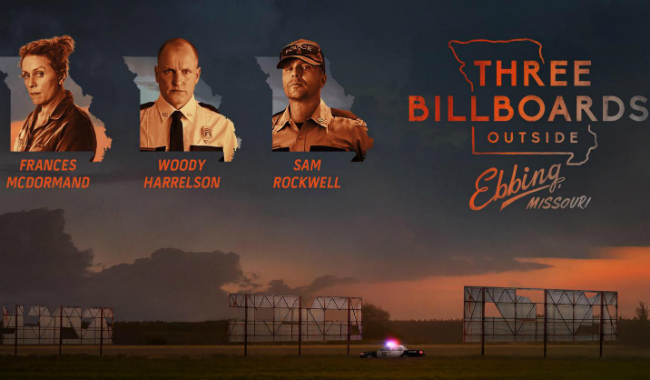
Ebbing, of course, is the setting for the Indie-darling film Three Billboards outside Ebbing, Missouri, which won the Golden Globe for best dramatic film, along with acting awards for lead actress Frances McDormand and supporting actor Sam Rockwell. It has been nominated for seven Oscars, including Best Picture.

McDormand plays Mildred Hayes, the grieving mother of a teenage daughter who had been raped and murdered seven months earlier. The local police department, headed by police chief Bill Willoughby (Woody Harrelson) and his dim-witted racist deputy Jason Dixon (Rockwell) have apparently been too busy harassing the African-Americans in town to investigate the crime. Dixon is Barney Fife to Willoughby’s Andy Taylor, with the same thinly veiled but deeply repressed homosexuality, which in Dixon’s case emerges in violent eruptions towards the towns gay advertising company owner and the African-Americans in his custody.

Image result for three billboards outside ebbing missouri
Hayes, a domestic abuse survivor and single mother, sponsors messages on three billboards accusing Willoughby of dragging his feet on the investigation. The billboards attract media attention and divide the community – most people siding with the police chief. But Hayes has the support of a company of outcasts – the gay billboard owner, two African-Americans, and the local dwarf with unrequited affection for Hayes. A series of melodramatic twists ensue, with escalating violence, with an ending that serves more as a Rorschach test than a resolution.

Ebbing is supposedly in the Ozarks of southern Missouri, where ignorant, poor white folk get their jollies harassing those who are “different.” But the film is all caricature rather than character, unlike the far superior 2010 film Winter’s Bone, set in the same locale. Sometimes the caricatures are played for cheap laughs (“It’s no longer n****r torture, it’s ‘people-of-color torture’”); sometimes it is played straight. But it’s always *played*. Events coincide too conveniently; there is violence but never accountability, and the offenders are given all-too-easy reconciliation. There is pseudo-wisdom (“anger only begets more anger”) and shallow theology – together with an ineffectual priest and cheap shots at organized religion.

The Oscar-nominated screenplay is by British writer-director Martin McDonagh (In Bruges), but rather than providing the insight of an outsider’s view of our society, it relies on caricature and lacks a true sense of place or regional culture. Despite having a realistic tone, it represents a Hollywood understanding of race and class in rural America, which may be why Hollywood has given it high praise. Like Trump’s own vision of America, it is a manufactured truth designed for emotional impact rather than something showing genuine understanding.

That having been said, the film has snappy dialogue, is well-paced, and has some of the best acting of any film this year, notably by the Oscar-nominated McDormand, Rockwell, and Harrelson, whose performances make the film worthy of seeing. It’s enjoyable in the same way as dining at Taco Bell and Panda Express – the food is mostly empty calories, but it’s tasty so long as you don’t mistake it for the real cuisine. Some critics call it “Coen Brothers lite.” I tend to agree.

2.5 stars out of 4.0. Rated R for excessive profanity, and some violence and gore.


Saturday, January 27, 2018

The Shape of WTF?!?


This week, Guillermo del Toro’s The Shape of Water led all films with 13 Academy Awards nominations, making it the early favorite for Best Picture of 2017. Del Toro is also heavily favored to win the Best Director Oscar, joining countrymen Alfonso Cuarón (Gravity, 2014) and Alejandro Iñárittu (Birdman, 2015 and The Revenant, 2016) as recent winners of the coveted award.

Del Toro, who not only directed, but also created the story and co-wrote the screenplay, seems to have developed The Shape of Water with Oscar in mind: it is an amalgam of every Hollywood “how to win an Oscar” cliché short of bashing Nazis. It has the “lost alien vs the military/ scientific/ industrial menace” theme; the “revenge against toxic masculinity, sexism, racism, ableism, and homophobia” theme; the “overcoming disability to discover true love” and the “my disability is a symbol of a social evil” themes; the “classic Hollywood movies as sacrament” theme; “the evil, Bible-quoting Christian” villain; and the “all you need is love” crowd-pleasing, fairy tale ending. Throw in some Mad Men 1960s-era cultural references for all the Baby Boomer voters of the Academy, and voilà – you have the perfect Oscar candidate.

Pardon me while I throw up. Some of my most revered film critics adore this mess, but to me, The Shape of Water is simply an over-the-top, silly, derivative fantasy about the evils of toxic masculinity that insults literate viewers more than it inspires.

From the incredulous opening credit sequence (heavy, metal objects don’t stay suspended in water, they sink) and the ridiculous opening bathtub scene to the E.T. meets The Little Mermaid (Feminist Fantasy Version) predictable ending, the film doesn’t utilize fantasy as a tool to expand our imagination (à la magical realism); rather, it severs all ties to reality and abuses fantasy for emotional manipulation and to score cheap political points.

For the record, The Shape of Water follows the plight of a Cold-War “asset” – a merman of sorts (played in scaly costume by Doug Jones) discovered in the Amazon with dual respiratory systems allowing him to live either on land or in water. He is brought to, confined at, and later enchained in, a secret lab in Baltimore where Elisa (Sally Hawkins) and Zelda (Octavia Spencer) are part of the custodial crew. Elisa is unable to speak, having suffered some unknown childhood condition that has left her with three parallel scars on either side of her neck, and no working vocal cords. The military-national security complex views the asset through Cold War eyes as a possible boon to space exploration (not really explained), and after some pointless torture with a cattle-prod by security agent Richard Strickland (cartoonishly played by Michael Shannon), the “brass” thinks it is more valuable to them as a post-mortem research subject. Meanwhile, Elisa, whose disability becomes an opportunity to communicate with the creature through sign language and music, recognizes a kindred spirit, and less convincingly, an object of love and desire. A semi-comic rescue sequence ensues, assisted by an embedded Soviet spy, with the now-iconic E.T. race to set the creature free. This is a Hollywood PC depiction of 1960s America: awash in toxic masculinity, toxic religion, white supremacy, fascism, and homophobia. The heroes are the women, gay men, minorities, and immigrants who love without judgment and resist without fear, all inspired by the stories of classic Hollywood either directly or by homage.

Del Toro is a student of film, and it shows. As a director who specializes in blending fantasy, horror, and romance he has drawn from a rich library of cinematic tropes, archetypes, texts, and references for the story, most notably The Creature from the Black Lagoon, E.T.: The Extra-Terrestrial, and his own Pan’s Labyrinth. But the most useful lens to view the film is as a counter-fantasy to Disney’s The Little Mermaid, which was excoriated by feminists upon its release for glamorizing a boy-crazy girl who gives up her voice to land her “prince.” The Shape of Water, by contrast, depicts a voiceless woman who nevertheless finds a “voice” to bring liberation and love to others. Not surprisingly, the initial symbol of her liberation is an egg – a uniquely female object.

Oddly, for a film literally saturated in water, the titular metaphor remains a mystery. Is it a metaphor of our origin and destiny (the film starts and ends underwater)? If so, I don’t quite see its relevance. It seems to exist more for effect than message. Even in the most ridiculous scene of the film, in which a good-sized bathroom is literally flooded to the ceiling (in a matter of minutes, with no structural consequences) the fantasy effect overwhelms both reason and meaning.

The mess of a story aside, the film is deserving of accolades for its technical brilliance. It is beautifully filmed, with a soundtrack and score (by Alexandre Desplat) that are wonderful. Some of the acting is exceptional, most notably Richard Jenkins as Giles, Elisa’s neighbor and friend; and Spencer. Hawkins is solid as Elisa, despite what she must endure in this ridiculous script.

Del Toro is a capable film-maker and will undoubtedly get his share of awards if for no other reason than he knows what buttons to push. As for me, all I could think after viewing the film was “WTF was that?!”

The Shape of Water is rated R for sex, nudity, gore, and violence. 2.0 stars out of 4 (2.5 stars out of 4 for film buffs).


Monday, May 25, 2015

Gods and Machines


Early in the new sci-fi film Ex Machina, reclusive high-tech billionaire Nathan Bateman reveals to his employee Caleb Smith that he has developed true artificial intelligence. When he suggests it might be the greatest invention “in the history of Man,” Smith corrects him: “It would be the greatest invention in the history of gods.”

By its very title, writer/director Alex Garland’s Ex Machina suggests divinity – in ancient Greek theater a “deus ex machina” is a plot twist involving divine intervention.  And the Promethean – or Satanic – quest to exercise god-like power is a major theme in this heady, well-written thriller.  In his directorial debut, Garland, at the top of whose short resume is a writing credit for 28 Days Later, has created a film that strives to join the pantheon of great films about artificial intelligence: 2001, Blade Runner, A.I., and Her, among others. And while Ex Machina lacks the lyricism of the aforementioned greats, it succeeds in raising some of the same existential questions: What makes something “human”? Are there moral limits to knowledge/technology? What does it mean to love?

The storyline of the film is fairly straightforward. Twenty-six year old Caleb Smith, a coder at Google-inspired "Bluebook," wins an employee lottery to spend a week with the company's eccentric, reclusive genius founder for an unknown purpose. Smith is flown to the genius's Fortress of Solitude in the subarctic north (it was filmed in Norway) which we learn is a research lab for creating artificial intelligence. Smith is to be the human tester of Ava, Bateman's humanoid creation, to see if she passes the famous Turing Test of whether true artificial intelligence – and human-like self-consciousness – has been attained. As might be expected, things get complicated in the central triangle of relationships, with enough Hitchcock-like suspense to have you questioning who is good, evil, or simply a victim of someone else's self-interest. 

Despite its effective use of special effects, Ex Machina is a small film that could easily have been a stage play. For 95% of the film, there are only four players: Nathan, played with the right mix of confidence, loneliness, and cool by Oscar Isaac (Inside Llewyn Davis); Caleb Smith (Domhnall Gleeson), the smart-but-naive coder; Ava, the beautiful “female” robot-creation (Alicia Vikander, who with six more films in production is this year’s “It” girl); and Kyoko, Nathan’s silent Japanese servant-girl (Sonoya Mizuno). The set design and art direction are very good despite an obviously limited budget.

As the character descriptions suggest, gender, sexuality, and objectification of women are major subthemes, and have provoked considerable debate in the blogosphere about whether or not this is a feminist, post-feminist, or anti-feminist film. Garland tries to play it both ways with unsatisfying results. The set-up is clearly misogynistic, with the males being the agents of creation and control and the females existing only to serve them, even sexually. We learn that Ava may have been designed from porn-search preferences; and that she is designed for sex – as Nathan brags, “in between her legs are a complex of sensors.” Nathan’s God-like omniscience – via constant surveillance – at times suggests voyeurism, and Garland incorporates significant female nudity in the film, though the men remain clothed. Garland tries to redeem this through an ending (no spoilers) that could be argued as humanist, feminist, or even cynical and portentous.

But the larger questions in Ex Machina are theological: the human quest to become as gods, what it means to be human, and the relationship between creature and creator. In regard to these, the film is better at raising questions than answering them. That is not inherently bad – the same could be said of 2001, arguably the greatest science-fiction film ever made. Garland is certainly well-read, and incorporates references, both direct and implicit, to the myths of Prometheus and Pygmalion, the Bhagavad-Gita, Hamlet, and more. The excellent score by Geoff Barrow and Ben Salisbury even incorporates the theme from Close Encounters of the Third Kind to good effect. 

Its flaws notwithstanding, Garland has made a taut, engaging, intelligent thriller. There are outstanding performances, especially by Isaac and Vikander. Still, you can't help but wonder what this film might have been with a more experienced director. Like it or hate it, one thing is sure – you will be talking about it afterward. 3.0 stars out of 4.0.

Friday, August 15, 2014

Chocolat, Partie Deux


It is a Lasse Hallstrom film about strangers who arrive in a small French village and set up shop selling soul-captivating food with exotic spices. They meet with resistance from the town’s most powerful resident. There is a forbidden romance as a subplot, and in the end, an important lesson is learned. No, it is not Chocolat, Hallstrom’s 2000 film with Juliette Binoche and Judi Dench. It is, rather, The Hundred-Foot Journey, which, although beautifully shot and acted, is essentially a remake of that earlier film with a few twists.

I suppose if you are going to rehash something, it is wise to rehash something good – and Chocolat is a classic. This time around, the strangers aren’t a morally suspect mother and daughter, but an expatriate family from India, driven from their homeland over some unexplained religious or political oppression.  Their food isn’t chocolate with magical Aztec spices, it is Indian cuisine with spices handed down from one generation to the next in a metal lockbox. Instead of Judi Dench as the aging matriarch, it is Helen Mirren. The essential familial bond is not mother-daughter, but father-son, and the romance isn’t between Binoche and Johnny Depp, but between American-born Manish Dayal and Charlotte Le Bon, who bears a striking resemblance to a young Winona Ryder.  And the lesson learned is not the value of the via positiva over religious moralism, but rather the value of cooperation over competition, and the celebration of difference.

The film is sensuously filmed, and the food images make one long for smell-o-vision, or better yet, taste-arama. Mirren is wonderful, as always, as an obstinate restaurateuse, and the other actors -- especially veteran Indian actor Om Puri (Charlie Wilson’s War, City of Joy) as Mirren’s equally obstinate foil -- are excellent.

However, the film never escapes its derivative elements, and the narrative arc is predictable. The third act is underdeveloped, and the resolution is weak. Despite these shortcomings, The Hundred-Foot Journey is an enjoyable if undemanding summer repast, that like all good meals, will leave you filled, but wanting more.  3.0 stars out of 4.0.

Saturday, July 26, 2014

Seized by the Moments

 In Boyhood, Richard Linklater has created a film of extraordinary vision and emotional power that is unlike any other film you’ve seen. The film, shot in 39 days over 12 years with the same cast, chronicles the life of Mason Evans, Jr. (Ellar Coltrane) from ages 6 to 18. The transition as he grows up is seamless, so that the emotional effect of his maturation is subtle but cumulative over the course of the film’s 165 minutes. By the time Mason leaves for college, we know why his mother (Patricia Arquette) is weeping, while also sharing Mason’s own sense of freedom and possibility on the cusp of adulthood.

We have seen child actors and their characters grow up before our eyes – from Ricky Nelson to Fred Savage to the kids of Modern Family. Michael Apted’s Seven-up documentaries have followed real-life children well into adulthood at seven-year intervals. Linklater’s “Before” trilogy (Before Sunrise, Before Sunset, Before Midnight) charts a relationship with the same actors roughly a decade apart over three films. But there has never been a film with the patience and commitment to follow a character’s growth to adulthood using the same actor in real time, and compress it into a single feature-length film.

There are no contrived crises in the film. There is no continuing plot, other than growing up. The film’s naturalism gives it the effect of a cinéma vérité documentary, as if An American Family had been filmed over more than a decade. This gives the film an intimacy that creates a powerful viewer bond. The intimacy is enhanced by Linklater’s casting of his daughter Lorelei in the role of Mason’s older sister. I don’t think a more accurate depiction of sibling relationships has ever been filmed.

But the universal is found in the particular, and the narrow longitudinal focus of the film raises deeper questions about American (and particularly Texan) assumptions about what is meant by “becoming a man,” as well as the effect our adult decisions and behaviors have on our children. The film takes aim at the problems created by our identification of alcohol use with adulthood, without being preachy or melodramatic.

Linklater both loves and understands his native state, and the film is shot with both a sense of place and a reverence for its geography. Having traveled widely in the state this past year, I found in the film a sense of recognition that did not devolve into caricature. Even a brief scene in a rural Texas church service rang true without mocking.

The acting in the principal roles is first rate, which I hope will be recognized at Oscar time, particularly for Coltrane, Arquette, and Ethan Hawke (who plays Mason Sr.). As is typical of Linklater films. the music score is spot-on with soundtrack selections that provide a sense of time, place, and character development.


Earlier this summer, we were given the tear-jerker coming of age film The Fault in our Stars. In Boyhood, we have a real-time coming-of-age film, in which the tears flow from the pain and beauty of an ordinary life. At one point in the film, a character comments, “People always say ‘seize the moment,’ but I think it’s more like the moments seize us.” In Boyhood, Linklater has presented a sequence of moments over the course of a childhood that are arresting in their poignancy. For those who want plot and action, the film may seem slow; but like childhood itself, if you bear with it you will be rewarded. A masterpiece. 4.0 stars out of 4.0.

Saturday, March 29, 2014

Noah and the Argonauts


Darren Aronofsky specializes in films that are painful to watch: the destructiveness of addiction in Requiem for a Dream; the physical brutality and abuse of The Wrestler; the psychotic self-mutilation of Black Swan. In Noah, the painful viewing is the gratuitous carnage of iron-age tribal warfare set in the period between two apocalypses – one caused by humans, the other by God.

Noah is not a biblical epic in any conventional sense. Context is manufactured out of whole cloth. One critic calls it "the Book of Genesis with a page one rewrite." Almost everything about the antediluvian world seems out of place. The landscape is anything but Middle Eastern (extensive sequences were filmed in Iceland); the costumes look like they came from Land’s End than from the ancient Near East (women in form-fitting pants and cloth jerkins?); the weapons are anachronistically iron-age, and even include a bazooka-like projectile launcher. The antediluvian earth is a world of reptilian goats, magical powers, fire-stones, and a race of stony giants called “watchers” in a bizarre interpretation of extra-biblical myth. (These "fallen angels" are so ridiculous that the producers excluded them from any pre-release publicity shots.) Noah has more in common with the old “dynamation” classics like Clash of the Titans and Jason and the Argonauts than The Ten Commandments or The Passion of the Christ.

Yet Noah still manages to be transparently preachy, a self-conscious diatribe about our contemporary ecological crisis. As the film begins, we are told that the “industrial society” of Cain’s descendants has ravaged and destroyed the earth – creating a post-apocalyptic landscape reminiscent of Mad Max or The Road. Noah and his family are the lone faithful remnant of the descendants of Seth, the keepers of the eco-friendly true religion of the Creator, nomads running from the bloodthirsty tribe of Tubal-Cain. The modern subtext later becomes explicit when Aronofsky incorporates images of modern warfare in Noah’s retelling of the story of creation and fall.  

But the issues in Noah are not only ecological. Aronofsky continues to unload his personal baggage with parents in Noah. Parents in his previous films are all deeply flawed people – self-destructive, abusive, and virtually incapable of love. In Noah, the title character is yet another abusive parent: a controlling leader of a family cult, a cold-blooded agent of “divine justice.” Noah is all moral contradiction, a religious sociopath depicted as a vegetarian who will risk his life to rescue an animal yet think nothing of slaughtering humans. But the ultimate abusive parent in Noah is God, whose genocidal impulse and emotional absence are never mitigated, whose justice is only tempered by defiant human compassion. In Noah, the rainbow is just a special effect without theological content.

The film will undoubtedly provoke discussion about care of creation, human and divine will, and the tension between justice and mercy. But the theological content emerges more from Aronofsky’s distortion of the biblical story rather than the source material, creating a confusing mess of biblical theology. Aronofsky proves the old preaching dictum that “a text without a context is a pretext.”

There are some redeeming elements in the film. The narrative structure creatively integrates biblical backstory as flashback. There are moments of visual brilliance, such as the aforementioned creation sequence (which even alludes to evolution). And the CGI action scenes are staged and edited with ferocious energy. But there are also major disappointments. The score is bombastic and overbearing. And, while Aronofsky is often regarded as an actor’s director (his previous four films have generated four Oscar nominations for acting, and one win), the acting in Noah is two-dimensional. Russell Crowe as Noah is alternately obsessed and aggrieved; Jennifer Connolly as Noah’s wife is given nothing for the first 90 minutes until she erupts in maternal rage. Poor Emma Watson as the wife of Shem cries so much in the film that one wonders if 40 days of rain was even necessary. Even Anthony Hopkins as Methuselah is more caricature than character.

Noah is painful to watch, and for all the wrong reasons. Save your money and pass on this silly pseudo-biblical eco-apocalypse fantasy. 1.5 stars out of 4.0.

Tuesday, February 25, 2014

Deconstructing a Construction Toy


My favorite Roger Ebert quote is, "What makes a movie good or bad is not what it's about.  It's how it is about what it's about."  This is the case with The LEGO Movie, which on the surface is a pedestrian - even cliche - children's animation film designed to sell toys. (This is among the most despicable of genres, often producing little more than 90 minute long badly written commercials.) However, The LEGO Movie subverts and transcends its genre and, while not a great movie, is one of the most important films of recent years.

The film starts by establishing the genre, launching us immediately into a backstory battle of good and evil with the obligatory oracle of a redeemer to come.  Don't worry about catching all the details up front - this is a family film after all, so the pretext will be repeated many times. When we shift to the narrative present, we are bombarded with the typically saccharine kid-movie elements, including a banal hyper electronic lollipop theme song ("Everything Is Awesome!")


It is at this point that we begin to appreciate that there are subtexts to the film that engage the pop-culturally proficient viewer. The first is the lurking awareness that writer-directors Phil Lord and Christopher Miller (Cloudy with a Chance of Meatballs) recognize the irony of the premise, namely that a mass produced toy made of painstakingly identical pieces can make someone "special" and "awesome."  They come dangerously close to devolving into either commercial exploitation on the one hand and self-parody on the other.  They manage to avoid both through the rapid-fire use of pop culture references and memes with occasional hilarious effect. (The Billy Dee Williams cameo alone is priceless.)  The references are quick and multi-layered, and will keep pop culture fans coming back for multiple viewings to catch them all. There is also a "revenge of the nerds" subtext at work in which fantasy-wonk geeks saves the day. I don't think it is coincidental that the central character is named "Emmet" (as in M-IT). 

But there is another dimension of the film that deserves kudos, namely the crafting of the film around the LEGO play experience.  The CG animation recreates an elaborate LEGO world that appears to live half in reality and half in fantasy, as if we were entering an imagined LEGO playworld.  The story replicates the dual desires to create and to destroy that fuel construction toy fantasies. (Which is more fun, to build something really cool or to blow it up afterward?)  The characters, which are a fantasy brigade of action heroes, sci-fi and fantasy movie icons, historical figures and ordinary LEGO people, break out of their individual narrative worlds to interact in a pop culture remix reminiscent of “Adult Swim” shows on the Cartoon Network, while also reflecting the imaginative flights of action-figure fantasy play.  The characters are co-creators of their world as LEGO-builders themselves, each with their distinctive styles (“Does anyone have black pieces? I only work in black!” says Batman). 

It is the use of remix pop culture and the participation of the characters as co-creators that make the film groundbreaking.  Films of video games have been noteworthy flops.  The LEGO Movie succeeds in replicating the video-game world where others have failed.


While the dialogue and acting are at times plastic (I had to say it), there are enough strong performances – particularly Elizabeth Banks as Wyldstyle and Will Arnett as her boyfriend Batman – and notable cameos (Morgan Freeman, Jonah Hill, and the aforementioned Mr. Williams, among others) to make this watchable.  And although the cinematography and editing are at times manic, they are always interesting and occasionally amazing.  The film will undoubtedly become a cult favorite among certain residents of Colorado and Washington.

There are some fairly accessible ways the film can be interpreted theologically.  There is a parabolic dimension to the film that becomes especially prominent in the third act (“Something can be made up and still be true…”).  The central themes of order vs. freedom, creativity vs. conformity, and self-preservation vs. organized resistance all have theological dimensions.  The surface narrative – set in a fascist dystopia run by “President Business” – has sufficient political resonance to be denounced on FOX News.  However, the ultimate moral – that ordinary people can harbor extraordinary gifts by just being themselves – seems too lightweight to carry the heft of the fantasy storyline. 

The LEGO Movie is no Citizen Kane, but it is a fresh and in some ways groundbreaking exercise in Saturday matinee filmmaking that will appeal to children and adults alike. I saw it in 3-D, which makes the most of the stunning visuals. 3.0 stars out of 4.0.

Thursday, January 16, 2014

A Folk Song Put to Film


Hang me, oh hang me, I’ll be dead and gone;
Hang me, oh hang me, I’ll be dead and gone.
I wouldn’t mind the hangin’,
It’s just the layin’ in the grave so long.
Poor boy… I’ve been all around this world.

Inside Llewyn Davis opens with this melancholy ballad which sets the tone for the rest of the film, about a soul wandering in a sea of loss and loneliness.

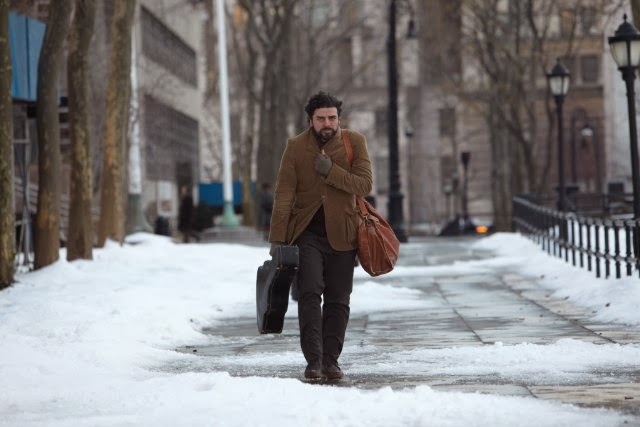
Llewyn Davis is a struggling folk singer in pre-Dylan Greenwich Village who doesn’t have enough money for a winter coat, much less an apartment to live in.  Played with subtlety and sympathy by Oscar Isaac, he is frequently a jerk and a boor, even to those who help him.  But he can also care for a displaced cat, sing a sea shanty for his neglected father, and manage to keep enough friends from whom to bum food and cigarettes, borrow money, and secure a couch to sleep on.  What is inside Llewyn Davis is a broken soul, an unwell spirit haunted by the suicide of his former singing partner.  His spirit is infused with and sometimes overcome by desperation to the point that we are given to wonder if he will take the advice of a would-be promoter and reunite with his (dead) partner.  As with all artists, the condition of his soul overflows into his work, in this case a repertoire of depressive folk songs and ballads.


As with writer/directors Joel and Ethan Coen’s earlier O Brother, Where Art Thou? the music – under the supervision of T Bone Burnett – is as much a part of the story as any character.  It is beautifully sung by Isaac himself – occasionally backed by Marcus Mumford (of Mumford and Sons) – and a supporting cast headed by Carey Mulligan and Justin Timberlake.  Like O Brother, Where Art Thou? the soundtrack stands alone as a quality album.  

The songs also reveal the tension in the music scene between the brooding minor key themes of the Village folk music scene and the breezy novelty songs that characterized the commercial folk market (illustrated in the film by the bouncy “Please Mr. Kennedy”).  But this also reflects the film’s subtext of social criticism.  Inside Llewyn Davis takes place a month after the inauguration of John Kennedy and his “New Frontier,” and offers a counterpoint to the myth of innocence and optimism it produced.  The late 50s and early 60s are often remembered nostalgically, but in reality it was a time of economic stagnation and high unemployment, an era when “retirement” meant “poverty”, and when women in trouble had to hunt for back-room abortionists.

But despite their attention to period detail and social context, the Coens are not making political statements as much as they are making statements about the human condition.  Indeed, a repeated line in the film tells us that a folk song "was never new and never gets old."  Inside Llewyn Davis is a folk song put to film.  

The central symbol of the film is the ginger cat which accompanies Llewyn on his journeys and serves as a projection of his inner self – what one critic called his “horcrux.”  The cat is accidentally set loose in the world and Llewyn is determined to bring him home.  The cat’s journey is also Llewyn’s, and the musical themes of voyage and homecoming are reiterated in Llewyn’s own backstory as a merchant marine and the son of a merchant marine (whose nursing home is named “Landfall”). 


The themes of birth and death are also prevalent, and are given their most poignant voice in the classic song, “The Death of Queen Jane,” which recounts the death in childbirth of Jane Seymour, wife of Henry VIII, who in the song pleads for a cesarean section to deliver her child, even though it would take her life.  Llewyn must confront demons of life and death at both ends of the life-journey, from abortion to suicide.  In their early film Raising Arizona the Coens portrayed family as an idealized community of wholeness and healing.  Llewyn Davis is conflicted over family:  he criticizes his friend Jean’s desire for a suburban life as a sell-out; he neglects his dying father; and he arranges abortions for the women he has impregnated.  Like Odysseus – another Coen meme – Llewyn Davis has been away from home too long, and is lost at sea trying to find his way back.

As with many Coen brothers films, the journey is filled with strange characters, not the least of whom is John Goodman’s relatively brief turn as a jaded heroin-addicted jazz musician, which provides some comic relief, believe it or not, even if it does seem thrown into the narrative as a contrivance.  Nevertheless the strangeness of the journey makes homecoming all the sweeter.

Inside Llewyn Davis is a well-crafted film.  It has received Oscar nominations for cinematography and sound mixing, both of which are deserved.  It is another very good film in a season of great films, which is probably why it was left on the honorable mention list of Best Picture nominees.  Nevertheless it is a film very much worth viewing, if for no other reason than the music and the cat.  3.5 stars/4.0