Saturday, February 3, 2018

Southern Exposure


Ebbing, Missouri is a lot like Cicely, Alaska, the setting of the 1990s TV show Northern Exposure. Both are small fictional towns filled with quirky individuals from a variety of backgrounds who all seem to know each other, and despite lacking formal education can summon culture and wisdom at odd times. Both, in their own ways, represent visions of American society. But whereas Cicely was a vision of Clinton-era America, where differences are celebrated and even the bigot and the homophobe can find a welcome, Ebbing is a vision of Trump-era America where differences are mocked and punished, and the racists and homophobes are in charge. If the former viewed America through rose-colored glasses, the latter shows it as in a fun-house mirror, full of bizarre and horrific distortions.

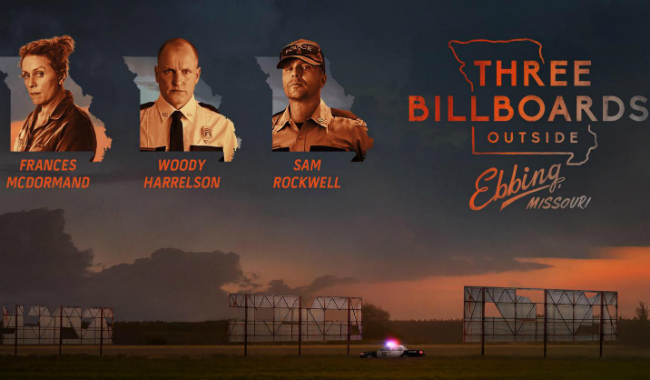
Ebbing, of course, is the setting for the Indie-darling film Three Billboards outside Ebbing, Missouri, which won the Golden Globe for best dramatic film, along with acting awards for lead actress Frances McDormand and supporting actor Sam Rockwell. It has been nominated for seven Oscars, including Best Picture.

McDormand plays Mildred Hayes, the grieving mother of a teenage daughter who had been raped and murdered seven months earlier. The local police department, headed by police chief Bill Willoughby (Woody Harrelson) and his dim-witted racist deputy Jason Dixon (Rockwell) have apparently been too busy harassing the African-Americans in town to investigate the crime. Dixon is Barney Fife to Willoughby’s Andy Taylor, with the same thinly veiled but deeply repressed homosexuality, which in Dixon’s case emerges in violent eruptions towards the towns gay advertising company owner and the African-Americans in his custody.

Image result for three billboards outside ebbing missouri
Hayes, a domestic abuse survivor and single mother, sponsors messages on three billboards accusing Willoughby of dragging his feet on the investigation. The billboards attract media attention and divide the community – most people siding with the police chief. But Hayes has the support of a company of outcasts – the gay billboard owner, two African-Americans, and the local dwarf with unrequited affection for Hayes. A series of melodramatic twists ensue, with escalating violence, with an ending that serves more as a Rorschach test than a resolution.

Ebbing is supposedly in the Ozarks of southern Missouri, where ignorant, poor white folk get their jollies harassing those who are “different.” But the film is all caricature rather than character, unlike the far superior 2010 film Winter’s Bone, set in the same locale. Sometimes the caricatures are played for cheap laughs (“It’s no longer n****r torture, it’s ‘people-of-color torture’”); sometimes it is played straight. But it’s always *played*. Events coincide too conveniently; there is violence but never accountability, and the offenders are given all-too-easy reconciliation. There is pseudo-wisdom (“anger only begets more anger”) and shallow theology – together with an ineffectual priest and cheap shots at organized religion.

The Oscar-nominated screenplay is by British writer-director Martin McDonagh (In Bruges), but rather than providing the insight of an outsider’s view of our society, it relies on caricature and lacks a true sense of place or regional culture. Despite having a realistic tone, it represents a Hollywood understanding of race and class in rural America, which may be why Hollywood has given it high praise. Like Trump’s own vision of America, it is a manufactured truth designed for emotional impact rather than something showing genuine understanding.

That having been said, the film has snappy dialogue, is well-paced, and has some of the best acting of any film this year, notably by the Oscar-nominated McDormand, Rockwell, and Harrelson, whose performances make the film worthy of seeing. It’s enjoyable in the same way as dining at Taco Bell and Panda Express – the food is mostly empty calories, but it’s tasty so long as you don’t mistake it for the real cuisine. Some critics call it “Coen Brothers lite.” I tend to agree.

2.5 stars out of 4.0. Rated R for excessive profanity, and some violence and gore.


Saturday, January 27, 2018

The Shape of WTF?!?


This week, Guillermo del Toro’s The Shape of Water led all films with 13 Academy Awards nominations, making it the early favorite for Best Picture of 2017. Del Toro is also heavily favored to win the Best Director Oscar, joining countrymen Alfonso Cuarón (Gravity, 2014) and Alejandro Iñárittu (Birdman, 2015 and The Revenant, 2016) as recent winners of the coveted award.

Del Toro, who not only directed, but also created the story and co-wrote the screenplay, seems to have developed The Shape of Water with Oscar in mind: it is an amalgam of every Hollywood “how to win an Oscar” cliché short of bashing Nazis. It has the “lost alien vs the military/ scientific/ industrial menace” theme; the “revenge against toxic masculinity, sexism, racism, ableism, and homophobia” theme; the “overcoming disability to discover true love” and the “my disability is a symbol of a social evil” themes; the “classic Hollywood movies as sacrament” theme; “the evil, Bible-quoting Christian” villain; and the “all you need is love” crowd-pleasing, fairy tale ending. Throw in some Mad Men 1960s-era cultural references for all the Baby Boomer voters of the Academy, and voilà – you have the perfect Oscar candidate.

Pardon me while I throw up. Some of my most revered film critics adore this mess, but to me, The Shape of Water is simply an over-the-top, silly, derivative fantasy about the evils of toxic masculinity that insults literate viewers more than it inspires.

From the incredulous opening credit sequence (heavy, metal objects don’t stay suspended in water, they sink) and the ridiculous opening bathtub scene to the E.T. meets The Little Mermaid (Feminist Fantasy Version) predictable ending, the film doesn’t utilize fantasy as a tool to expand our imagination (à la magical realism); rather, it severs all ties to reality and abuses fantasy for emotional manipulation and to score cheap political points.

For the record, The Shape of Water follows the plight of a Cold-War “asset” – a merman of sorts (played in scaly costume by Doug Jones) discovered in the Amazon with dual respiratory systems allowing him to live either on land or in water. He is brought to, confined at, and later enchained in, a secret lab in Baltimore where Elisa (Sally Hawkins) and Zelda (Octavia Spencer) are part of the custodial crew. Elisa is unable to speak, having suffered some unknown childhood condition that has left her with three parallel scars on either side of her neck, and no working vocal cords. The military-national security complex views the asset through Cold War eyes as a possible boon to space exploration (not really explained), and after some pointless torture with a cattle-prod by security agent Richard Strickland (cartoonishly played by Michael Shannon), the “brass” thinks it is more valuable to them as a post-mortem research subject. Meanwhile, Elisa, whose disability becomes an opportunity to communicate with the creature through sign language and music, recognizes a kindred spirit, and less convincingly, an object of love and desire. A semi-comic rescue sequence ensues, assisted by an embedded Soviet spy, with the now-iconic E.T. race to set the creature free. This is a Hollywood PC depiction of 1960s America: awash in toxic masculinity, toxic religion, white supremacy, fascism, and homophobia. The heroes are the women, gay men, minorities, and immigrants who love without judgment and resist without fear, all inspired by the stories of classic Hollywood either directly or by homage.

Del Toro is a student of film, and it shows. As a director who specializes in blending fantasy, horror, and romance he has drawn from a rich library of cinematic tropes, archetypes, texts, and references for the story, most notably The Creature from the Black Lagoon, E.T.: The Extra-Terrestrial, and his own Pan’s Labyrinth. But the most useful lens to view the film is as a counter-fantasy to Disney’s The Little Mermaid, which was excoriated by feminists upon its release for glamorizing a boy-crazy girl who gives up her voice to land her “prince.” The Shape of Water, by contrast, depicts a voiceless woman who nevertheless finds a “voice” to bring liberation and love to others. Not surprisingly, the initial symbol of her liberation is an egg – a uniquely female object.

Oddly, for a film literally saturated in water, the titular metaphor remains a mystery. Is it a metaphor of our origin and destiny (the film starts and ends underwater)? If so, I don’t quite see its relevance. It seems to exist more for effect than message. Even in the most ridiculous scene of the film, in which a good-sized bathroom is literally flooded to the ceiling (in a matter of minutes, with no structural consequences) the fantasy effect overwhelms both reason and meaning.

The mess of a story aside, the film is deserving of accolades for its technical brilliance. It is beautifully filmed, with a soundtrack and score (by Alexandre Desplat) that are wonderful. Some of the acting is exceptional, most notably Richard Jenkins as Giles, Elisa’s neighbor and friend; and Spencer. Hawkins is solid as Elisa, despite what she must endure in this ridiculous script.

Del Toro is a capable film-maker and will undoubtedly get his share of awards if for no other reason than he knows what buttons to push. As for me, all I could think after viewing the film was “WTF was that?!”

The Shape of Water is rated R for sex, nudity, gore, and violence. 2.0 stars out of 4 (2.5 stars out of 4 for film buffs).


Monday, May 25, 2015

Gods and Machines


Early in the new sci-fi film Ex Machina, reclusive high-tech billionaire Nathan Bateman reveals to his employee Caleb Smith that he has developed true artificial intelligence. When he suggests it might be the greatest invention “in the history of Man,” Smith corrects him: “It would be the greatest invention in the history of gods.”

By its very title, writer/director Alex Garland’s Ex Machina suggests divinity – in ancient Greek theater a “deus ex machina” is a plot twist involving divine intervention.  And the Promethean – or Satanic – quest to exercise god-like power is a major theme in this heady, well-written thriller.  In his directorial debut, Garland, at the top of whose short resume is a writing credit for 28 Days Later, has created a film that strives to join the pantheon of great films about artificial intelligence: 2001, Blade Runner, A.I., and Her, among others. And while Ex Machina lacks the lyricism of the aforementioned greats, it succeeds in raising some of the same existential questions: What makes something “human”? Are there moral limits to knowledge/technology? What does it mean to love?

The storyline of the film is fairly straightforward. Twenty-six year old Caleb Smith, a coder at Google-inspired "Bluebook," wins an employee lottery to spend a week with the company's eccentric, reclusive genius founder for an unknown purpose. Smith is flown to the genius's Fortress of Solitude in the subarctic north (it was filmed in Norway) which we learn is a research lab for creating artificial intelligence. Smith is to be the human tester of Ava, Bateman's humanoid creation, to see if she passes the famous Turing Test of whether true artificial intelligence – and human-like self-consciousness – has been attained. As might be expected, things get complicated in the central triangle of relationships, with enough Hitchcock-like suspense to have you questioning who is good, evil, or simply a victim of someone else's self-interest. 

Despite its effective use of special effects, Ex Machina is a small film that could easily have been a stage play. For 95% of the film, there are only four players: Nathan, played with the right mix of confidence, loneliness, and cool by Oscar Isaac (Inside Llewyn Davis); Caleb Smith (Domhnall Gleeson), the smart-but-naive coder; Ava, the beautiful “female” robot-creation (Alicia Vikander, who with six more films in production is this year’s “It” girl); and Kyoko, Nathan’s silent Japanese servant-girl (Sonoya Mizuno). The set design and art direction are very good despite an obviously limited budget.

As the character descriptions suggest, gender, sexuality, and objectification of women are major subthemes, and have provoked considerable debate in the blogosphere about whether or not this is a feminist, post-feminist, or anti-feminist film. Garland tries to play it both ways with unsatisfying results. The set-up is clearly misogynistic, with the males being the agents of creation and control and the females existing only to serve them, even sexually. We learn that Ava may have been designed from porn-search preferences; and that she is designed for sex – as Nathan brags, “in between her legs are a complex of sensors.” Nathan’s God-like omniscience – via constant surveillance – at times suggests voyeurism, and Garland incorporates significant female nudity in the film, though the men remain clothed. Garland tries to redeem this through an ending (no spoilers) that could be argued as humanist, feminist, or even cynical and portentous.

But the larger questions in Ex Machina are theological: the human quest to become as gods, what it means to be human, and the relationship between creature and creator. In regard to these, the film is better at raising questions than answering them. That is not inherently bad – the same could be said of 2001, arguably the greatest science-fiction film ever made. Garland is certainly well-read, and incorporates references, both direct and implicit, to the myths of Prometheus and Pygmalion, the Bhagavad-Gita, Hamlet, and more. The excellent score by Geoff Barrow and Ben Salisbury even incorporates the theme from Close Encounters of the Third Kind to good effect. 

Its flaws notwithstanding, Garland has made a taut, engaging, intelligent thriller. There are outstanding performances, especially by Isaac and Vikander. Still, you can't help but wonder what this film might have been with a more experienced director. Like it or hate it, one thing is sure – you will be talking about it afterward. 3.0 stars out of 4.0.

Friday, August 15, 2014

Chocolat, Partie Deux


It is a Lasse Hallstrom film about strangers who arrive in a small French village and set up shop selling soul-captivating food with exotic spices. They meet with resistance from the town’s most powerful resident. There is a forbidden romance as a subplot, and in the end, an important lesson is learned. No, it is not Chocolat, Hallstrom’s 2000 film with Juliette Binoche and Judi Dench. It is, rather, The Hundred-Foot Journey, which, although beautifully shot and acted, is essentially a remake of that earlier film with a few twists.

I suppose if you are going to rehash something, it is wise to rehash something good – and Chocolat is a classic. This time around, the strangers aren’t a morally suspect mother and daughter, but an expatriate family from India, driven from their homeland over some unexplained religious or political oppression.  Their food isn’t chocolate with magical Aztec spices, it is Indian cuisine with spices handed down from one generation to the next in a metal lockbox. Instead of Judi Dench as the aging matriarch, it is Helen Mirren. The essential familial bond is not mother-daughter, but father-son, and the romance isn’t between Binoche and Johnny Depp, but between American-born Manish Dayal and Charlotte Le Bon, who bears a striking resemblance to a young Winona Ryder.  And the lesson learned is not the value of the via positiva over religious moralism, but rather the value of cooperation over competition, and the celebration of difference.

The film is sensuously filmed, and the food images make one long for smell-o-vision, or better yet, taste-arama. Mirren is wonderful, as always, as an obstinate restaurateuse, and the other actors -- especially veteran Indian actor Om Puri (Charlie Wilson’s War, City of Joy) as Mirren’s equally obstinate foil -- are excellent.

However, the film never escapes its derivative elements, and the narrative arc is predictable. The third act is underdeveloped, and the resolution is weak. Despite these shortcomings, The Hundred-Foot Journey is an enjoyable if undemanding summer repast, that like all good meals, will leave you filled, but wanting more.  3.0 stars out of 4.0.

Saturday, July 26, 2014

Seized by the Moments

 In Boyhood, Richard Linklater has created a film of extraordinary vision and emotional power that is unlike any other film you’ve seen. The film, shot in 39 days over 12 years with the same cast, chronicles the life of Mason Evans, Jr. (Ellar Coltrane) from ages 6 to 18. The transition as he grows up is seamless, so that the emotional effect of his maturation is subtle but cumulative over the course of the film’s 165 minutes. By the time Mason leaves for college, we know why his mother (Patricia Arquette) is weeping, while also sharing Mason’s own sense of freedom and possibility on the cusp of adulthood.

We have seen child actors and their characters grow up before our eyes – from Ricky Nelson to Fred Savage to the kids of Modern Family. Michael Apted’s Seven-up documentaries have followed real-life children well into adulthood at seven-year intervals. Linklater’s “Before” trilogy (Before Sunrise, Before Sunset, Before Midnight) charts a relationship with the same actors roughly a decade apart over three films. But there has never been a film with the patience and commitment to follow a character’s growth to adulthood using the same actor in real time, and compress it into a single feature-length film.

There are no contrived crises in the film. There is no continuing plot, other than growing up. The film’s naturalism gives it the effect of a cinéma vérité documentary, as if An American Family had been filmed over more than a decade. This gives the film an intimacy that creates a powerful viewer bond. The intimacy is enhanced by Linklater’s casting of his daughter Lorelei in the role of Mason’s older sister. I don’t think a more accurate depiction of sibling relationships has ever been filmed.

But the universal is found in the particular, and the narrow longitudinal focus of the film raises deeper questions about American (and particularly Texan) assumptions about what is meant by “becoming a man,” as well as the effect our adult decisions and behaviors have on our children. The film takes aim at the problems created by our identification of alcohol use with adulthood, without being preachy or melodramatic.

Linklater both loves and understands his native state, and the film is shot with both a sense of place and a reverence for its geography. Having traveled widely in the state this past year, I found in the film a sense of recognition that did not devolve into caricature. Even a brief scene in a rural Texas church service rang true without mocking.

The acting in the principal roles is first rate, which I hope will be recognized at Oscar time, particularly for Coltrane, Arquette, and Ethan Hawke (who plays Mason Sr.). As is typical of Linklater films. the music score is spot-on with soundtrack selections that provide a sense of time, place, and character development.


Earlier this summer, we were given the tear-jerker coming of age film The Fault in our Stars. In Boyhood, we have a real-time coming-of-age film, in which the tears flow from the pain and beauty of an ordinary life. At one point in the film, a character comments, “People always say ‘seize the moment,’ but I think it’s more like the moments seize us.” In Boyhood, Linklater has presented a sequence of moments over the course of a childhood that are arresting in their poignancy. For those who want plot and action, the film may seem slow; but like childhood itself, if you bear with it you will be rewarded. A masterpiece. 4.0 stars out of 4.0.

Saturday, March 29, 2014

Noah and the Argonauts


Darren Aronofsky specializes in films that are painful to watch: the destructiveness of addiction in Requiem for a Dream; the physical brutality and abuse of The Wrestler; the psychotic self-mutilation of Black Swan. In Noah, the painful viewing is the gratuitous carnage of iron-age tribal warfare set in the period between two apocalypses – one caused by humans, the other by God.

Noah is not a biblical epic in any conventional sense. Context is manufactured out of whole cloth. One critic calls it "the Book of Genesis with a page one rewrite." Almost everything about the antediluvian world seems out of place. The landscape is anything but Middle Eastern (extensive sequences were filmed in Iceland); the costumes look like they came from Land’s End than from the ancient Near East (women in form-fitting pants and cloth jerkins?); the weapons are anachronistically iron-age, and even include a bazooka-like projectile launcher. The antediluvian earth is a world of reptilian goats, magical powers, fire-stones, and a race of stony giants called “watchers” in a bizarre interpretation of extra-biblical myth. (These "fallen angels" are so ridiculous that the producers excluded them from any pre-release publicity shots.) Noah has more in common with the old “dynamation” classics like Clash of the Titans and Jason and the Argonauts than The Ten Commandments or The Passion of the Christ.

Yet Noah still manages to be transparently preachy, a self-conscious diatribe about our contemporary ecological crisis. As the film begins, we are told that the “industrial society” of Cain’s descendants has ravaged and destroyed the earth – creating a post-apocalyptic landscape reminiscent of Mad Max or The Road. Noah and his family are the lone faithful remnant of the descendants of Seth, the keepers of the eco-friendly true religion of the Creator, nomads running from the bloodthirsty tribe of Tubal-Cain. The modern subtext later becomes explicit when Aronofsky incorporates images of modern warfare in Noah’s retelling of the story of creation and fall.  

But the issues in Noah are not only ecological. Aronofsky continues to unload his personal baggage with parents in Noah. Parents in his previous films are all deeply flawed people – self-destructive, abusive, and virtually incapable of love. In Noah, the title character is yet another abusive parent: a controlling leader of a family cult, a cold-blooded agent of “divine justice.” Noah is all moral contradiction, a religious sociopath depicted as a vegetarian who will risk his life to rescue an animal yet think nothing of slaughtering humans. But the ultimate abusive parent in Noah is God, whose genocidal impulse and emotional absence are never mitigated, whose justice is only tempered by defiant human compassion. In Noah, the rainbow is just a special effect without theological content.

The film will undoubtedly provoke discussion about care of creation, human and divine will, and the tension between justice and mercy. But the theological content emerges more from Aronofsky’s distortion of the biblical story rather than the source material, creating a confusing mess of biblical theology. Aronofsky proves the old preaching dictum that “a text without a context is a pretext.”

There are some redeeming elements in the film. The narrative structure creatively integrates biblical backstory as flashback. There are moments of visual brilliance, such as the aforementioned creation sequence (which even alludes to evolution). And the CGI action scenes are staged and edited with ferocious energy. But there are also major disappointments. The score is bombastic and overbearing. And, while Aronofsky is often regarded as an actor’s director (his previous four films have generated four Oscar nominations for acting, and one win), the acting in Noah is two-dimensional. Russell Crowe as Noah is alternately obsessed and aggrieved; Jennifer Connolly as Noah’s wife is given nothing for the first 90 minutes until she erupts in maternal rage. Poor Emma Watson as the wife of Shem cries so much in the film that one wonders if 40 days of rain was even necessary. Even Anthony Hopkins as Methuselah is more caricature than character.

Noah is painful to watch, and for all the wrong reasons. Save your money and pass on this silly pseudo-biblical eco-apocalypse fantasy. 1.5 stars out of 4.0.

Tuesday, February 25, 2014

Deconstructing a Construction Toy


My favorite Roger Ebert quote is, "What makes a movie good or bad is not what it's about.  It's how it is about what it's about."  This is the case with The LEGO Movie, which on the surface is a pedestrian - even cliche - children's animation film designed to sell toys. (This is among the most despicable of genres, often producing little more than 90 minute long badly written commercials.) However, The LEGO Movie subverts and transcends its genre and, while not a great movie, is one of the most important films of recent years.

The film starts by establishing the genre, launching us immediately into a backstory battle of good and evil with the obligatory oracle of a redeemer to come.  Don't worry about catching all the details up front - this is a family film after all, so the pretext will be repeated many times. When we shift to the narrative present, we are bombarded with the typically saccharine kid-movie elements, including a banal hyper electronic lollipop theme song ("Everything Is Awesome!")


It is at this point that we begin to appreciate that there are subtexts to the film that engage the pop-culturally proficient viewer. The first is the lurking awareness that writer-directors Phil Lord and Christopher Miller (Cloudy with a Chance of Meatballs) recognize the irony of the premise, namely that a mass produced toy made of painstakingly identical pieces can make someone "special" and "awesome."  They come dangerously close to devolving into either commercial exploitation on the one hand and self-parody on the other.  They manage to avoid both through the rapid-fire use of pop culture references and memes with occasional hilarious effect. (The Billy Dee Williams cameo alone is priceless.)  The references are quick and multi-layered, and will keep pop culture fans coming back for multiple viewings to catch them all. There is also a "revenge of the nerds" subtext at work in which fantasy-wonk geeks saves the day. I don't think it is coincidental that the central character is named "Emmet" (as in M-IT). 

But there is another dimension of the film that deserves kudos, namely the crafting of the film around the LEGO play experience.  The CG animation recreates an elaborate LEGO world that appears to live half in reality and half in fantasy, as if we were entering an imagined LEGO playworld.  The story replicates the dual desires to create and to destroy that fuel construction toy fantasies. (Which is more fun, to build something really cool or to blow it up afterward?)  The characters, which are a fantasy brigade of action heroes, sci-fi and fantasy movie icons, historical figures and ordinary LEGO people, break out of their individual narrative worlds to interact in a pop culture remix reminiscent of “Adult Swim” shows on the Cartoon Network, while also reflecting the imaginative flights of action-figure fantasy play.  The characters are co-creators of their world as LEGO-builders themselves, each with their distinctive styles (“Does anyone have black pieces? I only work in black!” says Batman). 

It is the use of remix pop culture and the participation of the characters as co-creators that make the film groundbreaking.  Films of video games have been noteworthy flops.  The LEGO Movie succeeds in replicating the video-game world where others have failed.


While the dialogue and acting are at times plastic (I had to say it), there are enough strong performances – particularly Elizabeth Banks as Wyldstyle and Will Arnett as her boyfriend Batman – and notable cameos (Morgan Freeman, Jonah Hill, and the aforementioned Mr. Williams, among others) to make this watchable.  And although the cinematography and editing are at times manic, they are always interesting and occasionally amazing.  The film will undoubtedly become a cult favorite among certain residents of Colorado and Washington.

There are some fairly accessible ways the film can be interpreted theologically.  There is a parabolic dimension to the film that becomes especially prominent in the third act (“Something can be made up and still be true…”).  The central themes of order vs. freedom, creativity vs. conformity, and self-preservation vs. organized resistance all have theological dimensions.  The surface narrative – set in a fascist dystopia run by “President Business” – has sufficient political resonance to be denounced on FOX News.  However, the ultimate moral – that ordinary people can harbor extraordinary gifts by just being themselves – seems too lightweight to carry the heft of the fantasy storyline. 

The LEGO Movie is no Citizen Kane, but it is a fresh and in some ways groundbreaking exercise in Saturday matinee filmmaking that will appeal to children and adults alike. I saw it in 3-D, which makes the most of the stunning visuals. 3.0 stars out of 4.0.